3 Days Tour From Errachidia to Fes: The Ultimate Desert-to-Medina Guide
Last updated: April 2026 — Morocco Service Tours
Table of Contents
ToggleWhat You Need to Know Before You Book
3 Days/ 2 Nights
Planning a 3-day tour from Errachidia to Fes? Here’s the short version most guides skip:
- Route: Errachidia → Ziz Valley → Merzouga Sahara → Erfoud → Rissani → Midelt → Azrou Cedar Forest → Ifrane → Fes
- Best for: Travelers landing at Errachidia airport (ERH) who want to experience the Sahara and end the trip in Fes — without backtracking
- Price range: $180–$420 per person depending on group size and camp level (standard vs. luxury)
- Duration: 3 days / 2 nights
- 3-step action plan:
- Book a private tour in advance (group tours are almost non-existent on this specific route)
- Choose your camp type — standard (shared bathrooms) or luxury (ensuite private tents)
- Arrive in Errachidia in the evening so Day 1 starts fresh — most ERH flights land late anyway
Unlike generic Morocco itineraries, this guide is specifically built for the Errachidia starting point
Why Do the 3-Day Tour From Errachidia to Fes in 2026?
Most Morocco travelers fly into Marrakech or Casablanca. But flying into Errachidia (ERH) is one of the smartest moves you can make — and almost no mainstream travel blog talks about why.
Here’s the thing: Errachidia sits at the gateway of everything dramatic in southeastern Morocco. The Ziz Valley stretches south from the city, the Sahara begins just 50km away at Merzouga, and Fes — the cultural soul of Morocco — lies 340km to the north. The 3-day route from Errachidia to Fes covers that entire arc in a logical, stunning sequence.
Why this route wins in 2026:
- No wasted driving. You start in the desert and end in the medina — nothing is doubled back
- Maximum scenery per kilometre — Ziz gorges, Sahara dunes, cedar forests, alpine towns
- Off-peak advantage — ERH sees far fewer tour groups than Marrakech or Fes starting points
- Ideal post-flight gateway — Moulay Ali Cherif Airport is just 3km from the city centre, and flights often arrive in the evening — perfect for an early morning Day 1 departure
Most guides focus on the Marrakech-to-Fes direction. This guide covers the Errachidia-to-Fes route specifically — a leaner, more desert-focused version that solo travelers, couples, and photographers love.
Day-by-Day Itinerary: Errachidia to Fes in 3 Days
Day 1: Errachidia → Ziz Valley → Merzouga Sahara
Your driver picks you up from your hotel (or Moulay Ali Cherif Airport) early in the morning — typically around 8:00–8:30 AM.
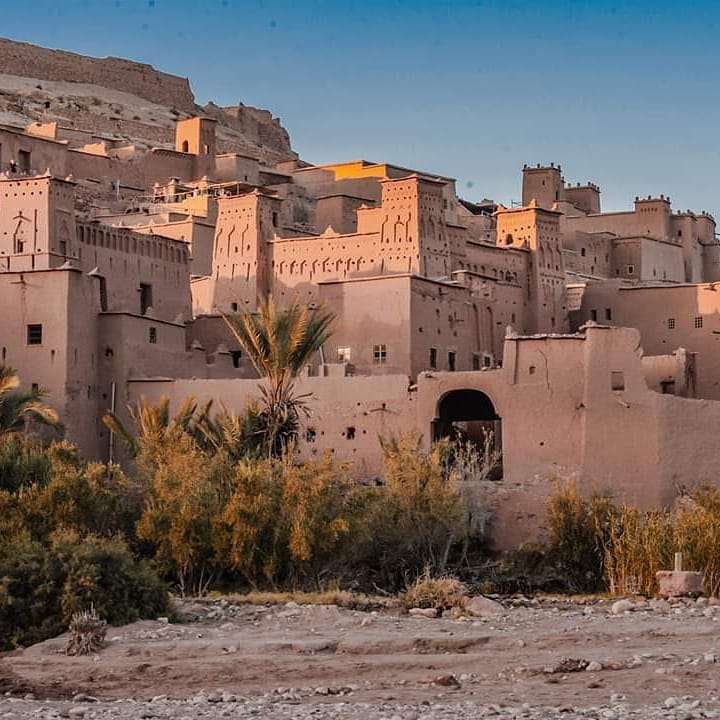
First stop: the Ziz Valley. The road south immediately rewards you. The Ziz River carves through a canyon of palm groves, ancient ksars (fortified villages), and golden cliffs. Most tours rush through this section — ask your driver to stop at the panoramic viewpoint above the valley. It’s one of the most photogenic spots in Morocco and rarely crowded at this hour.
Erfoud: the fossil capital. Before reaching the dunes, you’ll pass through Erfoud — a town famous for its black marble workshops filled with prehistoric fossils embedded in stone. A quick stop here takes 20–30 minutes and makes for a genuinely unique souvenir experience. Most generic itineraries don’t mention this stop at all.
Rissani: the market nobody tells you about. Rissani was the ancient capital of the Tafilalet region and is still an active trading hub. If your tour falls on a Tuesday, Thursday, or Sunday, you’ll catch the famous souk — a chaotic, authentic market selling live animals, spices, and traditional Berber goods. This is real Morocco, not a tourist market.
Afternoon: Erg Chebbi dunes and camel trek. By mid-afternoon, you arrive at Merzouga — the edge of Erg Chebbi, one of Morocco’s largest and most spectacular erg (sand sea). A camel handler and camels will be waiting. The trek to the desert camp takes around 60–90 minutes, arriving perfectly for sunset over the dunes.
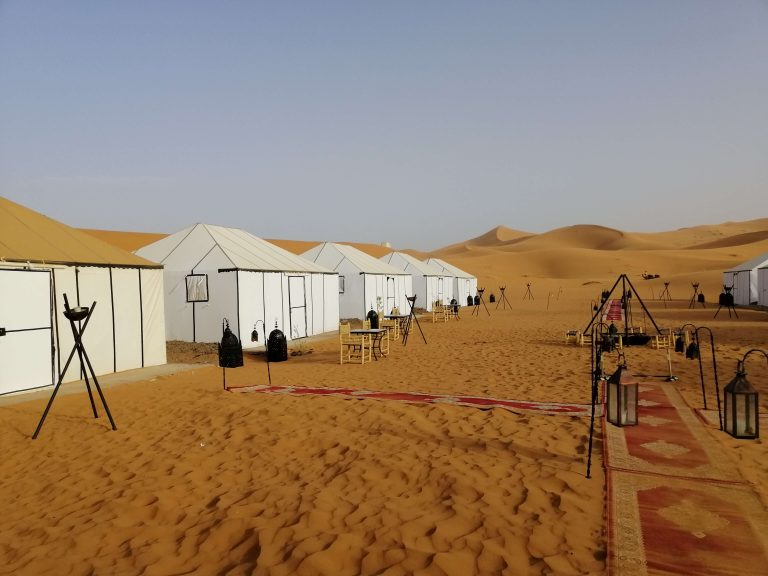
Evening: Desert camp. Dinner is included. Berber music and drumming happen around a campfire. The sky above the Sahara — with zero light pollution — is something you genuinely cannot prepare for.
Practical tip: Wear layers. Desert temperatures drop sharply after sunset, even in spring and autumn. Blankets are provided in camps, but a light jacket in your daypack matters.
Day 2: Merzouga Desert Exploration
Most 3-day tours rush out of Merzouga on Day 2. Morocco Service Tours builds a full second day of desert exploration — and it makes a real difference.
Sunrise at the dunes. Wake before dawn and climb the nearest high dune ridge. The light show at sunrise is a photographer’s dream — soft pinks and golds across an ocean of sand.
Morning 4×4 desert circuit. After breakfast, a local driver takes you through the desert by 4×4 to explore the less-visited corners of the erg:
- Khamlia village — a small settlement of descendants of Sudanese slaves, known for their powerful Gnawa music performances. This is a cultural experience that feels completely removed from the tourist circuit. (See also: Gnawa music in Morocco)
- Nomadic family visit — a brief stop with a Berber nomadic family living near the Algerian border, offering tea and a glimpse into a lifestyle unchanged for centuries
- Merzouga lake (seasonal) — a wetland just north of the dunes that attracts flamingos in winter and spring — another detail most guides completely miss
- Fossil and eyeliner mine — a small artisan operation worth a short stop
Afternoon: Sandboarding on the dunes, optional quad bike rental (at extra cost), or simply relaxing at a café at the edge of the sand with mint tea.
For more on what’s possible in this area, our detailed guide to things to do in Morocco’s Sahara Desert covers it all.
Day 3: Merzouga → Midelt → Azrou → Ifrane → Fes
This is the day that separates this route from everything else in Morocco. The drive from the Sahara to Fes passes through four completely different ecosystems — desert, semi-arid plateau, alpine forest, and European-style mountain town — all in one day.
Ziz Valley panoramic stop (again, from a different angle heading north). The light is completely different in the morning, and the valley looks almost lush compared to the surrounding desert.
Midelt: lunch in the apple town. Midelt sits between the High Atlas and Middle Atlas mountains and is famous for its apple orchards. It’s a natural lunch stop — local restaurants here serve solid tagines at fair prices.
Azrou cedar forest. One of the genuine surprises of this route. Ancient cedar trees create a forest that feels more like Canada than North Africa. The Barbary macaques — large, wild monkeys — live freely here and will approach vehicles. Do not feed them human food, despite what vendors might suggest. A handful of nuts bought from a local stall is fine.
Ifrane: Morocco’s Switzerland. The town is genuinely bizarre in the best way. European-style chalet architecture, manicured lawns, and a clean, quiet atmosphere — completely jarring after two days in the Sahara. Stop for coffee and a short walk. The famous stone lion sculpture in the town centre is worth a photo.
Arrive Fes: late afternoon. Your driver drops you at your riad or hotel in Fes. The tour ends here.
If you’re extending your trip, Fes deserves at least 2 days on its own. Our complete Morocco travel itinerary covers exactly how to structure time in the medina.
Included :
* Accommodation
* Service of pickup and drop-off
* Breakfast and dinner
*English/Spanish/ french speaking driver
* Medina's official guide
* Camel trip and overnight in the Desert Camp(per Person)
Excluded :
*Monument admission costs.
* Lunches and beverages
Pricing: What Does This Tour Actually Cost in 2026?
Most competitor pages list vague ranges. Here is a realistic breakdown:
| Group Size | Standard Camp | Luxury Camp (ensuite tent) |
|---|---|---|
| 1 person (solo) | ~$280–$320 pp | ~$380–$420 pp |
| 2 people (couple) | ~$220–$260 pp | ~$300–$360 pp |
| 3–4 people | ~$180–$220 pp | ~$260–$310 pp |
Note: Prices vary by season. October–November and March–April are peak season; expect slightly higher rates. January–February is low season — good value.
Compared to starting a desert tour from Marrakech, the Errachidia-based route is typically 15–25% cheaper because you eliminate 2 days of driving from a major city. That’s a real financial advantage that almost no guide mentions.
For additional budget planning, see Morocco on a budget.
Standard vs. Luxury Desert Camp: Which One Is Right For You?
This is a decision most travelers make without enough information. Here’s the honest comparison:
| Feature | Standard Camp | Luxury Camp |
|---|---|---|
| Tent type | Shared or semi-private | Private ensuite |
| Bathroom | Communal (outside tent) | Private, inside tent |
| Beds | Mattresses on floor | Proper beds with linen |
| Ambiance | Authentic, rustic | Comfortable, romantic |
| Best for | Solo travelers, backpackers | Couples, families, special occasions |
| Price difference | Base | +$60–$100 per person |
Our honest take: For most travelers, the standard camp is perfectly fine and more authentic. If you’re on a honeymoon or celebrating something, the luxury camp is genuinely worth it — waking up in a private tent with a Sahara sunrise through the door is hard to beat.
See our Morocco itinerary for honeymooners if you’re planning a romantic trip.
5 Things Most Tour Guides Don’t Tell You About This Route
These are the gaps that generic blogs skip — and knowing them will make your trip significantly better:
1. Most ERH flights land in the evening. Plan to spend your first night in Merzouga or near the dunes — not in Errachidia itself. Your tour should factor this in. A good operator will pick you up at the airport and drive the 50km south to Merzouga the same night, so you lose zero time.
2. The Rissani souk is only worth it on market days. Tuesday, Thursday, and Sunday only. If your tour runs on a different day, Rissani becomes a brief pass-through. Not every guide will adjust the itinerary around this — ask in advance.
3. The Khamlia Gnawa performance is not a tourist trap if done right. Some operators take you to staged, rushed performances at roadside spots. A good guide takes you into the village itself for an informal session. Ask specifically about this before booking. More on what to watch for: Khamlia village — tourist trap or not?
4. Ifrane gets cold, even in April. The town sits above 1,600m. If you’re visiting March–May or September–November, pack a layer specifically for the Ifrane stop — you’ll thank yourself.
5. The drive on Day 3 is long. Errachidia to Fes is roughly 340km, but with stops, it runs 7–8 hours of total travel. This is the tradeoff of the route — it’s scenic but not leisurely. If you want to slow down, ask about splitting Day 3 with an overnight in Midelt (this turns it into a 4-day tour).
Ready to Book Your 3-Day Tour From Errachidia to Fes?
This is one of Morocco’s most rewarding point-to-point journeys — desert to medina, with everything dramatic in between. And because it starts in Errachidia rather than Marrakech, you skip the tourist crowds without missing any of the highlights.
Browse Morocco Service Tours packages →
Or if you’re comparing options, our 3-day tour from Errachidia to Marrakech runs the same route in reverse through Todra Gorges and the High Atlas.
Have questions? Check our TripAdvisor reviews or find us on Google Maps.
Related articles to explore next:
FAQ: 3 Days From Errachidia to Fes
-
How long is the drive from Errachidia to Fes directly?
Without stops, it's approximately 5.5 hours (340km). With sightseeing at the Ziz Valley, Midelt, Azrou, and Ifrane, the full Day 3 runs 7–8 hours including lunch.
-
Is this tour available as a group tour or only private?
This specific route from Errachidia is almost exclusively private. Unlike Marrakech-based tours, there aren't enough travelers starting from ERH to run shared group departures reliably. This is actually an advantage — private means flexible, and you set the pace.
-
Can I do camel trekking with kids?
Yes. Camel treks at Erg Chebbi are family-friendly and the camels are handled by experienced guides. The 60–90 minute trek to camp is manageable for children 5 and up. See our Sahara desert tour with kids guide for detailed family planning advice.
-
What is the best time of year for this tour?
March–May and October–November are ideal. Spring brings cool desert days and possible Merzouga lake flamingos. Autumn has warm dunes and mild mountain temperatures. Summer (June–August) is very hot in the Sahara — temperatures exceed 40°C — and is not recommended unless you specifically prefer heat. Winter is cold but spectacular for stargazing.
-
Why don't other tour operators mention the Erfoud fossil workshops or Rissani souk?
Most operators running higher-volume tours skip these stops to keep the schedule tight. At Morocco Service Tours, we include them because they're genuinely interesting — and they cost nothing extra. These are the kinds of local details that make the difference between a drive and a real experience.
-
What happens if I want to extend the tour to 4 or 5 days?
Easy. We can add overnight stays in Midelt, Azrou, or even Ifrane to break up Day 3. We can also extend the desert time in Merzouga. Reach out via custom Morocco tours and we'll build it around your schedule.
Tour's Map
Contact Us
Get In Touch
Talk To Us
moroccoservicetours@gmail.com
PHONE NUMBER
Tél:0661503108- 0662496367
ADDRESS
LOT Merzouga N311,
Arfoud, 52200