Best 3 Days Morocco Tour From Marrakech in 2026: The Complete Itinerary Guide
Everything You Need to Know
3 Days/ 2 Nights
A 3-day Morocco tour from Marrakech is the most popular short desert itinerary in the country — and for good reason. In just 72 hours, you can cross the High Atlas Mountains, explore a UNESCO World Heritage kasbah, walk through a 300-metre canyon, ride a camel at sunset, and sleep under a billion Saharan stars.
Two main options exist for this 3-day route:
- Round-trip: Marrakech → Desert → back to Marrakech (best if you’re based in Marrakech)
- One-way to Fes: Marrakech → Desert → Fes (best if you’re continuing your Morocco journey north)
Price range: €135–€300 per person (group) | €400–€1,500+ per person (private), depending on group size and accommodation tier.
3-step action plan:
- Choose your end point — return to Marrakech or continue to Fes?
- Pick private over group if you’re traveling as a couple or family
- Book 6–8 weeks ahead during peak season (October–April)
this article also covers the often-skipped details: which stops are actually worth slowing down for, where groups waste time, and what most tour operators won’t tell you upfront.
Why 3 Days From Marrakech Is the Sweet Spot for Most Travelers
Most travelers visiting Morocco have between 7 and 14 days total. A 3-day desert tour from Marrakech hits the ideal balance — enough time to genuinely experience the Sahara without losing a full week to driving.
The honest truth, though, is that 3 days on this route involves a lot of driving. The Marrakech to Merzouga distance alone is 560 km — roughly a 9-hour journey. What makes or breaks the trip is how that driving time is broken up, and which stops your guide actually invests time in versus which ones get a 10-minute rush.
A well-designed 3-day itinerary overnights in the Dades Valley on night one, reaches Merzouga for the desert experience on night two, and drives to either Marrakech or Fes on day three. That structure works. A poorly designed one tries to reach Merzouga on day one — and leaves you exhausted before the best part even begins.
🔗 If you have more time available, see 4 Days Morocco Travel From Marrakech for a more relaxed version of this route — with a full day in the Sahara.
Option A vs Option B: Which 3-Day Tour Is Right for You?
Most competitors list a single 3-day itinerary. In reality, there are two distinct versions of this tour, and choosing the wrong one can leave you backtracking unnecessarily across Morocco.
| Feature | Round-Trip (Marrakech → Marrakech) | One-Way (Marrakech → Fes) |
|---|---|---|
| Best for | Travelers based in Marrakech | Travelers continuing to Fes, Chefchaouen, or north |
| Return drive | Long (9–10 hrs back) | None — you end in Fes |
| Value for time | Lower | Higher |
| Scenery variety | Same route both ways | New landscapes on the return (Ziz Valley, cedar forests) |
| Price difference | Slightly less | Slightly more (longer overall distance) |
| Recommended for | Couples, solo travelers | Families, itinerary-builders |
The verdict: If your Morocco trip includes Fes — which it should — book the Marrakech to Fes version. You see entirely different landscapes on the way back, you don’t repeat a 9-hour drive, and you arrive in one of the world’s great medieval cities ready to explore. It’s simply a smarter use of 3 days.
🔗 Already in Fes and heading south? We also offer the 3-Day Sahara Desert Tour From Fes going the other direction.
The Full 3-Day Morocco Itinerary From Marrakech
Day 1: Marrakech → Ait Ben Haddou → Dades Valley
Driving: ~5–6 hours total (with stops) | Overnight: Dades Valley
Your driver collects you from your hotel or riad between 7:00–8:00 AM. The earlier the better — morning light in the High Atlas Mountains is spectacular, and Ait Ben Haddou gets crowded by midday.
Morning: The High Atlas Crossing
The first major landmark is the Tizi n’Tichka pass — a winding mountain road that climbs to 2,260 metres above sea level. The drive through the High Atlas is genuinely beautiful: red-rock valleys, scattered Berber villages, and sudden views down into deep gorges. Most guides make a brief photo stop here. Ask yours to stop at one of the small roadside stalls — local women sell argan oil products, and a mint tea with a view costs next to nothing.
Late Morning: Ait Ben Haddou
The Kasbah of Ait Ben Haddou is a UNESCO World Heritage Site and one of the most photographed places in Morocco. This fortified mud-brick city was once a vital stopover on the ancient caravan route linking the Sahara with Marrakech. It later became one of cinema’s favourite locations — Gladiator, Game of Thrones, The Mummy, and Lawrence of Arabia all filmed scenes here.
Walk up to the top of the ksar for the best view over the Ounila River and the surrounding plains. Give yourself at least 45 minutes — it’s more interesting than it looks from the outside.
The small village of Ait Ben Haddou across the river from the ksar is where real families still live. Cross the stepping stones and walk through — it’s completely authentic and almost entirely tourist-free.
Afternoon: Ouarzazate and the Road of 1001 Kasbahs
After lunch near Ait Ben Haddou, you’ll pass through Ouarzazate — Morocco’s “Hollywood of Africa,” where major international productions have filmed for decades. The Atlas Film Studios here are the largest in the world by area. A quick stop is worthwhile; a full tour is optional and adds €10–15 per person.
From here, the road follows the Valley of Roses and the famous Road of 1001 Kasbahs — a long corridor of mud-brick fortresses, palm groves, and ochre rock formations stretching east through the pre-Saharan plains. This drive is one of the most cinematic in Morocco.
Evening: Dades Valley
You’ll arrive in the Dades Valley (also called Boumalne Dades) by early evening. This is your overnight stop. The valley is flanked by dramatic red-rock canyon walls, and a short walk from most guesthouses gives you a view of the Dades Gorge that few tourists bother to seek out. Dinner at your riad is typically a traditional tagine.
Day 2: Dades Valley → Todra Gorge → Merzouga Desert
Driving: ~4–5 hours + activities | Overnight: Sahara desert camp
Morning: Todra Gorge
After breakfast, it’s a scenic drive east to Tinghir and then into the Todra Gorge — a narrow limestone canyon where the walls rise to 300 metres on either side and a cold shallow river runs along the base. The light inside the gorge is extraordinary in the morning hours, and the canyon narrows to just 10 metres at its tightest point.
Most tours give visitors 20–30 minutes here. Push for 45. Walk past the main tourist section into the quieter upper canyon — the crowds thin out almost immediately.
Late Morning: Erfoud and Rissani
The road continues east through Erfoud, famous for its fossilized trilobite marble (the workshops along the road are legitimate and worth a 15-minute stop), and then Rissani — the historic birthplace of the Alaouite dynasty that still rules Morocco today. The weekly souk in Rissani is one of the most authentic markets in southeast Morocco. Most tours drive through without stopping, which is a genuine miss.
Afternoon: Merzouga and the First Camel Ride
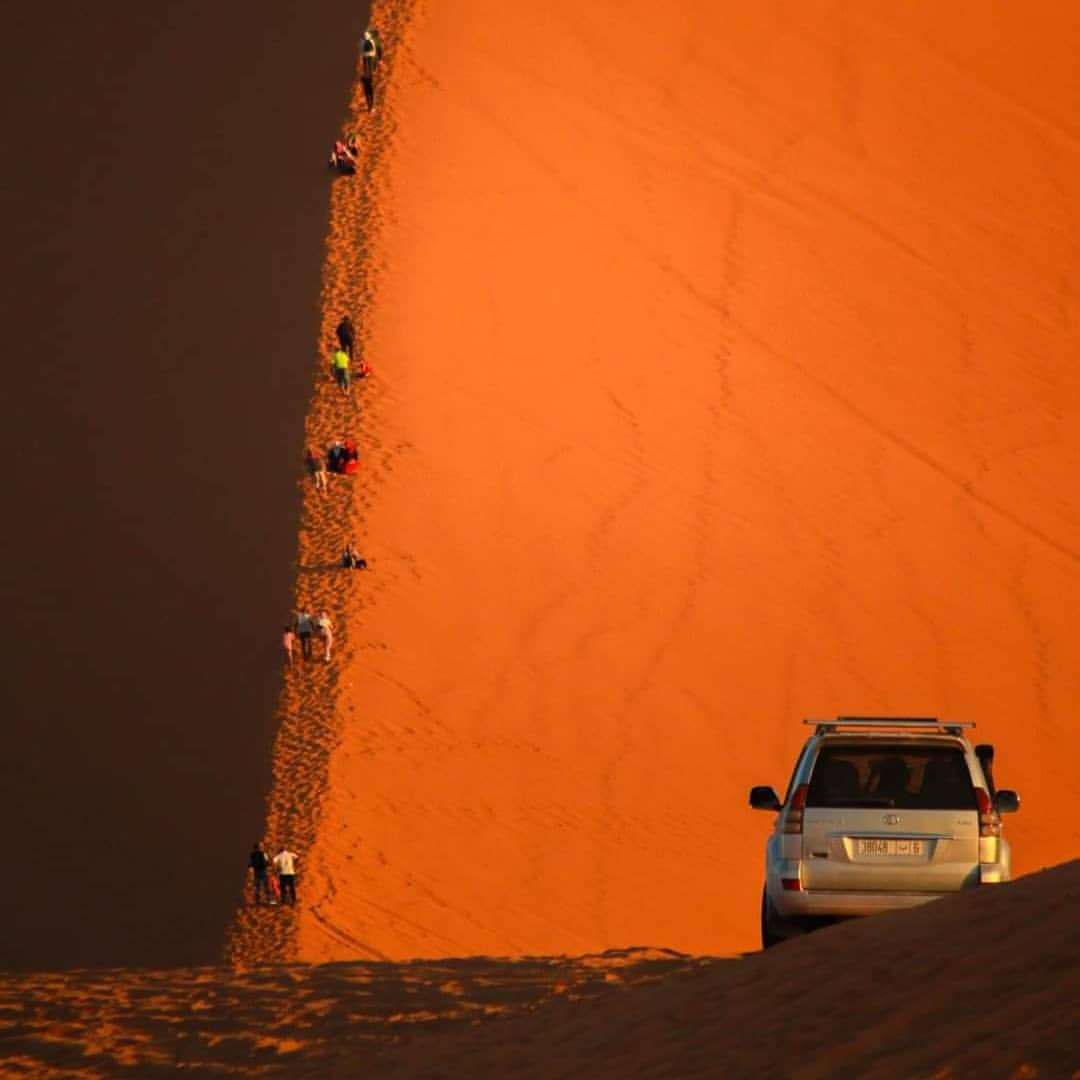
By late afternoon, the flat desert horizon ahead of you suddenly breaks into something extraordinary — the orange dunes of Erg Chebbi rising up to 150 metres, glowing in the low afternoon sun. This is Morocco’s most iconic Sahara landscape.
Your camel caravan is waiting at the edge of the dunes. The sunset ride into the desert takes approximately one hour — long enough to feel the silence, watch the dunes shift colour from gold to deep amber, and completely disconnect from everything.
Evening in the Desert Camp
Your desert camp is nestled inside the dunes. After arriving, you’ll be welcomed with mint tea, followed by a traditional Moroccan dinner of tagine and couscous eaten around a fire. Local Gnawa drummers and musicians often perform in the evening — a beautiful, authentic experience that has nothing to do with the tourist-facing version in Marrakech’s Jemaa el-Fna square.
Sleep with the tent flap open if you can. The sky above Erg Chebbi on a clear night is one of the most spectacular sights in the world.
🔗 Want to understand Gnawa music and its deep cultural roots before you go? Read our guide to Gnawa Music in Morocco.
Day 3 (Option A — Round-Trip): Merzouga → Return to Marrakech
Driving: ~9–10 hours | Drop-off: Marrakech
Wake before dawn (around 5:30 AM) to climb a dune and watch the Sahara sunrise — the most memorable moment of the entire trip for many travelers. After breakfast at the camp, a jeep or camel ride returns you to Merzouga village.
The return drive to Marrakech is long. Your guide will suggest a slightly different route via the Draa Valley — Morocco’s longest river valley, lined with date palms and ancient fortified villages — which breaks up the monotony and adds beautiful scenery. Expect to arrive in Marrakech by early evening (7–9 PM). Do not book a flight on this day. Book your flight for the following morning minimum.
Day 3 (Option B — Marrakech to Fes): Merzouga → Fes
Driving: ~7–8 hours | Drop-off: Fes
This is the smarter option for travelers continuing their Morocco journey north.
After sunrise and breakfast, you head northwest toward Errachidia and into the Ziz Valley — a dramatic palm-lined gorge that most travelers on the round-trip route never see. The road passes through date oases that feel genuinely remote and unchanged.
Continuing north through the Middle Atlas Mountains, you’ll pass through Midelt (a good lunch stop), then into cedar forests where wild Barbary macaques — Morocco’s only native primates — are frequently spotted roadside. This section of the drive is genuinely memorable and completely different to anything you experienced on the way south.
You’ll arrive in Fes in the late afternoon or early evening — one of the world’s great ancient cities, with a medina so complex it has barely changed since the 14th century. Your driver drops you at your accommodation and the 3-day adventure is complete.
🔗 Planning to explore Fes? Read our 7-Day Morocco Itinerary From Fes for where to go next.
Included :
* Accommodation
* Service of pickup and drop-off
* Breakfast and dinner
*English/Spanish/ french speaking driver
* Medina's official guide
* Camel trip and overnight in the Desert Camp(per Person)
Excluded :
*Monument admission costs.
* Lunches and beverages
Tour's Map
Price Guide: 3-Day Morocco Tour From Marrakech in 2026
| Tour Type | Price Per Person | Best For |
|---|---|---|
| Budget shared group | €135–€200 | Solo travelers, backpackers |
| Mid-range shared group | €200–€300 | First-timers, social travelers |
| Private standard | €350–€600 | Couples, small groups of 2–4 |
| Private mid-range | €600–€900 | Comfort travelers, families |
| Private luxury | €900–€1,500+ | Premium camps, 4-star riads |
Important: The 3-day Marrakech-to-Fes tour costs slightly more than the round-trip version due to total distance. Prices drop significantly per person as group size increases — a private tour for 4 people is often only marginally more expensive than 4 individual group tour spots.
🔗 Traveling on a tighter budget? Read our guide to Morocco on a Budget for smart ways to save without sacrificing the experience.
How to Choose the Best 3-Day Morocco Tour: 5 Things to Check
1. Verify the Desert Camp Location
Many budget camps are positioned near the road, not inside the dunes. Always ask: “Is the camp inside Erg Chebbi, or near the edge?” A camp deep in the dunes means silence, darkness, and a genuine desert sky. One near the road means noise, light pollution, and disappointment.
2. Ask About Group Size
Shared group tours should have a maximum of 10–12 people per vehicle. Anything larger becomes a convoy experience, not a tour. Ask before you book.
3. Confirm What “Breakfast Included” Actually Means
Some operators count a small bread roll and tea as breakfast. Others serve a full traditional spread. Clarify this, especially at the desert camp where food quality varies widely.
4. Check Driver vs. Guide Credentials
Many tours use drivers who also act as guides. That’s fine — but verify that your driver speaks good English and has genuine local knowledge, not just a standard script. Reviews on TripAdvisor and Google are your most reliable signal.
5. Read the Cancellation Policy
Peak season tours (October–April) fill quickly and may have stricter cancellation terms. Budget tours sometimes require full payment upfront with no refund. Understand this before you pay.
🔗 For a full overview of tour styles and options: Guide to Morocco Tours
Best Time to Take the 3-Day Marrakech Desert Tour
| Month | Desert Conditions | Recommendation |
|---|---|---|
| October – November | Warm days (25–30°C), cool nights | ⭐⭐⭐⭐⭐ Ideal |
| December | Cold nights (2–8°C), clear skies | ⭐⭐⭐⭐ Great for star-gazing |
| January – February | Cold but sunny and uncrowded | ⭐⭐⭐⭐ Good — dress warmly |
| March – April | Perfect temperatures, Valley of Roses blooms | ⭐⭐⭐⭐⭐ Peak season |
| May | Warming up — still pleasant | ⭐⭐⭐⭐ Good |
| June – August | 42–48°C in the desert | ⭐ Avoid if possible |
| September | Transitioning — improving fast | ⭐⭐⭐ Acceptable |
🔗 Thinking about a winter trip? Travel to Morocco in January covers what to expect season by season.
Packing List: What You Actually Need for 3 Days
Most tour lists are either too long or too vague. Here’s what genuinely matters for this specific itinerary:
Must-bring:
- Layers for the desert night — even in spring, Sahara temperatures drop sharply after dark
- Closed-toe shoes or boots for camel trekking (sandals are uncomfortable on a saddle and bad on canyon paths)
- A warm jacket for Day 1’s mountain crossing — the Tizi n’Tichka pass can be cold year-round
- Cash in MAD — villages around Merzouga and Rissani have unreliable ATMs
- Power bank — desert camps have limited charging
- Headscarf or buff — wind-driven sand is relentless in the dunes
- Sunscreen SPF 50+ and lip balm — desert sun is intense
Leave behind:
- Large suitcases (use a soft duffel bag — luggage goes in the vehicle boot)
- Excessive outfits (you’ll be in a car or the desert most of the time)
- Valuables you can’t afford to lose to sand
🔗 Full packing guidance: What to Pack for Your Trip to Morocco
FAQ: 3 Days Morocco Tour From Marrakech
Is 3 days enough for the Sahara from Marrakech? Yes — if the itinerary is well-structured. Three days gives you one genuine desert night, meaningful stops at Ait Ben Haddou and Todra Gorge, and a camel ride at sunset. It’s not leisurely, but it’s enough. If you want a full day in the dunes without rushing, upgrade to 4 days.
Should I book the round-trip or the Marrakech-to-Fes version? If your Morocco itinerary includes Fes — which we strongly recommend — book the one-way version. You cover more of the country, see entirely different landscapes on day three, and avoid repeating a 9-hour drive. It’s the better value for your time.
What’s the difference between a shared group tour and a private tour? A shared tour puts you in a minivan with 8–12 strangers on a fixed schedule. Stops are predetermined and time-limited. A private tour gives you a vehicle, driver, and guide exclusively. You can linger at a viewpoint, adjust the pace, skip stops that don’t interest you, and add ones that do. For couples and families, private almost always wins.
Is it safe to take a desert tour as a solo female traveler? Yes. The Marrakech–Merzouga corridor is one of the most traveled tourist routes in Morocco and is very safe. Thousands of solo female travelers take this tour every year without issues. Choose a reputable operator with verified reviews. See Traveling to Morocco as a Woman for detailed guidance.
Do I need to tip my guide/driver? Tipping is not mandatory but is customary and genuinely appreciated. The standard is €5–10 per person per day for a well-run private tour. For a shared group tour, €5–10 total for the driver at the end is a kind gesture.
Why do some tour operators advertise day trips to the Sahara from Marrakech? Because there’s demand for them. But here’s the truth: a day trip from Marrakech cannot reach the real Sahara. The minimum one-way drive to Erg Chebbi is 9 hours. “Day trips to the desert” from Marrakech typically visit the Agafay Desert — a rocky, arid plateau about 40 minutes from the city. It’s scenic but it has no dunes, no camels in the dunes, and no desert camp. If seeing the actual Sahara matters to you, a minimum of 3 days is non-negotiable.
Book Your 3-Day Morocco Tour From Marrakech
At Morocco Service Tours, we run both the round-trip and Marrakech-to-Fes versions of this itinerary as fully private experiences. Every driver is local, every camp is hand-selected, and every itinerary is built around your group’s pace and preferences.
Whether you’re a solo traveler joining a small shared group or a family looking for a private 4×4 with a dedicated guide, we have the right option for you.
👉 View our 3-day Morocco tour from Marrakech — or contact us directly for a custom quote. We respond within 24 hours.
Related Articles to Read Next

- 3-Day Sahara Desert Tour From Fes — doing the route in reverse
- Best 3 Days Desert Trip From Marrakech — our most popular short tour
- 2 Days Desert Tour From Marrakech — if your time is truly limited
- Tours From Marrakech — Full Overview — all departure options
- Sahara Desert Tours in Morocco — compare all desert itineraries
- Morocco Itinerary for Honeymooners — for couples planning a romantic desert trip
- Is Morocco Safe for Tourists? — essential reading before you travel
Contact Us
Get In Touch
Talk To Us
PHONE NUMBER
Tél:0661503108- 0662496367
ADDRESS
LOT Merzouga N311,
Arfoud, 52200